ABSTRACT
- Two novel bacterial strains, designated HNIBRBA15423T and 25HG05S-40T, were isolated from the root of a halophyte and from a riverbank soil in the Republic of Korea, respectively. Cells of both strains were Gram-stain-negative, yellow-pigmented, non-motile, and rod-shaped. Phylogenetic analysis based on 16S rRNA gene sequences revealed that both strains belong to the genus Flavobacterium. Strains HNIBRBA15423T and 25HG05S-40T showed the highest sequence similarity to Flavobacterium jejuense EC11T (98.5%) and Flavobacterium dankookense ARSA-19T (98.3%), respectively. The major cellular fatty acids of both strains included iso-C15:0, iso-C15:1 G, and iso-C17:0 3-OH. Both strains contained menaquinone-6 as the respiratory quinone and phosphatidylethanolamine as the major polar lipid. The complete genome sizes and DNA G + C contents were 4.29 Mb and 29.7% for strain HNIBRBA15423T, and 3.45 Mb and 36.6% for strain 25HG05S-40T. The average nucleotide identity (ANI) and digital DNA-DNA hybridization (dDDH) values were calculated. For HNIBRBA15423T, ANI value compared to F. jejuense EC11T were 85.2% with dDDH value of 29.5%. For 25HG05S-40T, ANI values compared to F. dankookense DSM 25687T and F. wongokense WG47T were 76.0% and 78.6%, respectively, with dDDH value of 20.3% and 21.5%. Based on the polyphasic taxonomic data, strains HNIBRBA15423T and 25HG05S-40T represent two novel species within the genus Flavobacterium, for which the names Flavobacterium suaedicola sp. nov. and Flavobacterium wonjuense sp. nov. are proposed.
-
Keywords: Flavobacterium, novel species, halophyte, soil
Introduction
The genus Flavobacterium, a member of the family Flavobacteriaceae within the phylum Bacteroidota, was first proposed by Bergey et al. (1923) and its description has subsequently been emended (Bernardet et al., 1996; Dong et al., 2013; Kang et al., 2013; Kuo et al., 2013). Since the first species, Flavobacterium aquatile, members of the genus have been found in a wide range of ecological habitats, including freshwater (Jo et al., 2023), seawater (Kitahara et al., 2023), algae (Park et al., 2015), soil (Yoon et al., 2006), rhizosphere (Kämpfer et al., 2025), and freshwater fish (Kämpfer et al., 2020). Most species of the genus Flavobacterium are Gram-negative, aerobic, rod-shaped bacteria that lack flagella and exhibit are yellow to orange color due to the presence of flexirubin-type pigments or carotenoids. Menaquinone-6 (MK-6) as the predominant respiratory quinone and phosphatidylethanolamine as major polar lipids were typically found in Flavobacterium species (Bernardet and Bowman, 2006; Bernardet et al., 2002). Regarding genomic characteristics, the genomes of the genus Flavobacterium range in size from 2.3 to 6.1 Mb, with a DNA G + C content of 29.4 to 50.9% (Kim et al., 2023). Metabolic analysis of Flavobacterium genomes revealed a wide range of enzymes, including agarase, cellulase, chitinase, chitosanase, dextranase, hyaluronidase, lysozyme, xylanase, and α-glucosidase (Jo et al., 2023). The genus is well known not only for its wide distribution, but also for its ecological role in degrading a wide range of high-molecular-weight organic compounds and complex polysaccharides in diverse environments (Lian et al., 2025; Yang et al., 2025).
As of July 2026, the genus Flavobacterium comprises 412 species validly published species according to the List of Prokaryotic names with Standing in Nomenclature (LPSN) (Parte et al., 2020). Among Flavobacterium species, 112 species have been isolated from diverse habitats in the Republic of Korea. In the present study, during our ongoing survey of indigenous bacterial diversity in Korea, we obtained two novel bacterial strains, designated HNIBRBA15423T and 25HG05S-40T, from the root of the halophyte Suaeda maritima and riverbank soil, respectively. In this study, whole-genome analysis of strains HNIBRBA15423T and 25HG05S-40T revealed complete circular genomes of 4.29 Mb and 3.45 Mb, respectively. Based on these polyphasic taxonomic and genomic distinctions, we propose that these strains represent two novel species of the genus Flavobacterium.
Materials and Methods
Isolation and strains
Strain HNIBRBA15423T was isolated from the root of halophyte Suaeda maritima collected in Taean, the Republic of Korea (36°49′49.9′′ N, 126°10′48.2′′ E) in June 2024. The root sample was gently cleansed with sterilized phosphate buffered saline (PBS) solution and subsequently homogenized by a sterilized pestle. Supernatant of the homogenized sample was inoculated on marine agar 2216 (MA; BD Diagnostics) and incubated at 20°C for seven days. Although initially isolated on MA, strain HNIBRBA15423T was found to grow well on R2A agar, which was subsequently used for routine culture and characterization to ensure consistent testing conditions with other reference strains. Strain 25HG05S-40T was isolated from a riverbank soil sample collected from Wonju, the Republic of Korea (37°23′7.8′′ N, 127°59′10.4′′ E) in December 2024. The soil sample was serially diluted with sterilized PBS solution. Aliquots of the serially diluted solution were plated onto R2A agar (BD Diagnostics) and incubated at 20°C for seven days. Two distinct yellow-pigmented colonies, designated HNIBRBA15423T and 25HG05S-40T, were selected, purified by repeated streaking on R2A agar, and routinely cultured at 25°C. For long-term preservation, the purified strains were stored as glycerol suspensions (20%, v/v) at -80°C. For phenotypic and chemotaxonomic comparisons, closely related type strains were selected based on 16S rRNA gene sequence similarities (Flavobacterium jejuense KCTC 42149T, Flavobacterium dankookense KCTC 23179T, and Flavobacterium profundi KACC 18559T) and inclusion of the type species of the genus (Flavobacterium aquatile KACC 11692T). These type strains were obtained from the Korean Collection for Type Cultures (KCTC) and Korean Agricultural Culture Collection (KACC), respectively, and cultured on R2A agar at 25°C alongside the novel strains under identical conditions.
16S rRNA gene phylogeny
Genomic DNA of strain HNIBRBA15423T and 25HG05S-40T were extracted using the DNeasy Blood and Tissue kit (Qiagen) according to the manufacturer’s instructions. The 16S rRNA genes of the strains were amplified by PCR using universal primers 27F and 1492R (Weisburg et al., 1991) and sequenced by a Sanger sequencer (Macrogen) and subsequently identified using the 16S-based ID application in the EzBioCloud (Chalita et al., 2024). To clarify the phylogenetic position, MEGA version 11 (Tamura et al., 2021) was employed to generate phylogenetic trees based on 16S rRNA gene sequences aligned with the ClustalW (v1.83) integrated in to MEGA11 (Thompson et al., 1994). The resultant phylogenetic trees were constructed based on maximum-likelihood method (Felsenstein, 1981) with the Tamura-Nei model, neighbor-joining method (Saitou and Nei, 1987) with the Kimura-2 model, and minimum-evolution method (Fitch, 1971) with Jukes-Cantor correction. Robustness of the trees was ensured by bootstrap analysis based on 1,000 random replicates (Felsenstein, 1985).
Whole genomic analyses
Whole genome sequencing was performed using PacBio HiFi long-read sequencing with a 20 kb SMRTbell library (Macrogen). The resultant long reads were de novo assembled using the Microbial Assembly Application in SMRT Link (v13.0). Whole genome sequence was annotated with the NCBI Prokaryotic Genome Annotation Pipeline (PGAP) (Tatusova et al., 2016) and metabolic pathways were inferred using BlastKOALA with reference to the KEGG pathway database (Kanehisa et al., 2016). In order to investigate degradation potential, a search for carbohydrate-active enzymes was performed with dbCAN3 (Zheng et al., 2023). For analyzing genomic relationship, Flavobacterium genomes available from the NCBI genome database were downloaded. To depict a genome-based phylogenetic tree, a set of 92 universal bacterial core genes were extracted from the Flavobacterium genomes using the up-to-date bacterial core gene set and pipeline (UBCG) (Na et al., 2018), and subjected to reconstruct a phylogenomic tree using FastTree (Price et al., 2009). The average nucleotide identity (ANI) values were calculated using ANI Calculator (Yoon et al., 2017). Digital DNA-DNA hybridization (dDDH) values were estimated using the GGDC website (http://ggdc.dsmz.de/distcalc2.php) (Meier-Kolthoff et al., 2022).
Morphological, physiological, and chemotaxonomic analyses
The morphological characteristics and the presence of flagella were investigated using transmission electron microscopy (TEM, Hitachi) based on negative staining with 1% (v/v) uranyl acetate. Gram staining was determined using the Gram Stain kit (bioMérieux). Catalase and oxidase activities were determined by spraying 3% (v/v) H2O2 solution and Kovac’s reagent (bioMérieux) onto fresh colonies, respectively. Growth range and optimal temperature were evaluated at nine different temperatures (4, 10, 15, 20, 25, 30, 35, 37, and 45°C) in R2A broth (R2B; BD Diagnostics). Effect of pH was examined in R2B adjusted to pH 5.0–10.0 at increments of pH 1.0 intervals. The pH media were buffered using MES, MOPS, HEPES, and CHES to maintain pH values of 5.0, 6.0, 7.0–8.0, and 9.0–10.0, respectively. NaCl requirement was tested in R2B, followed by supplementing with 0–5% (w/v) at increments of 0.5% NaCl intervals. Cellular growth was determined by measuring optical cell density at 600 nm using a UV-Vis spectrophotometer (Optizen POP-V). Growth under anaerobic conditions was monitored using the AnaeroPackTM (Mitsubishi Gas Chemical) at 25°C up to two weeks. Hydrolysis of starch (1%, w/v), CM-cellulose (1%, w/v), and casein (3%, w/v) was investigated on R2A medium supplemented with these substrates. Hydrolysis of CM-cellulose was confirmed by drenching the colonies with 0.1% (w/v) Congo red solution and rinsing with 1 M NaCl. Degradation of DNA was investigated by clear zones surrounding colonies on DNase agar supplemented with methyl green (Kisan Bio). Other enzymatic and metabolic features of six Flavobacterium strains were evaluated through the application of API test systems (ZYM and 20NE, bioMérieux) and GENIII MicroPlates (BIOLOG) according to the manufacturer's instructions.
The cellular fatty acid profiles of six Flavobacterium strains were analyzed by gas chromatography (Agilent 7890B GC system). For fatty acid extraction, biomass was collected from colonies grown on the same sectors of R2A plates after incubating at 25°C until the mid-exponential phase was reached. The fatty acids were saponified, methylated, and extracted in accordance with the standard protocol of the MIDI (Microbial Identification System) (Sasser, 1990). The resulting fatty acid methyl esters were identified using the TSBA6 database of the MIDI (Sherlock ver. 6.2). The analysis of respiratory quinones and polar lipids was carried out using the analytical services of the Korean Culture Center of Microorganisms (KCCM). Respiratory quinones and polar lipids were extracted from freeze-dried cells according to the method described by Minnikin et al. (1984). The extracted quinones were purified using thin-layer chromatography and subsequently analyzed by high-performance liquid chromatography (HPLC) (Collins and Jones, 1981). Polar lipid extracts were separated using two-dimensional thin-layer chromatography (TLC) on 10 × 10 cm silica gel-coated plates (Merck). After developing in chloroform/methanol/water (65:25:3.8) and chloroform/acetic acid/methanol/water (40:7.5:6:1.8), functional group-containing lipids were identified by spraying the plates with solutions of molybdophosphate, ninhydrin, molybdenum blue, α-naphthol, and Dragendorf's reagent (Minnikin et al., 1977).
Nucleotide sequence accession numbers
The 16S rRNA gene sequences of strains HNIBRBA15423T and 25HG05S-40T have been deposited in the GenBank/EMBL/DDBJ databases under accession numbers PZ097109 and PV555167, respectively. The complete genome sequences of HNIBRBA15423T and 25HG05S-40T are available under accession numbers CP199751 and CP199750, respectively.
Results and Discussion
Molecular phylogenetic analysis
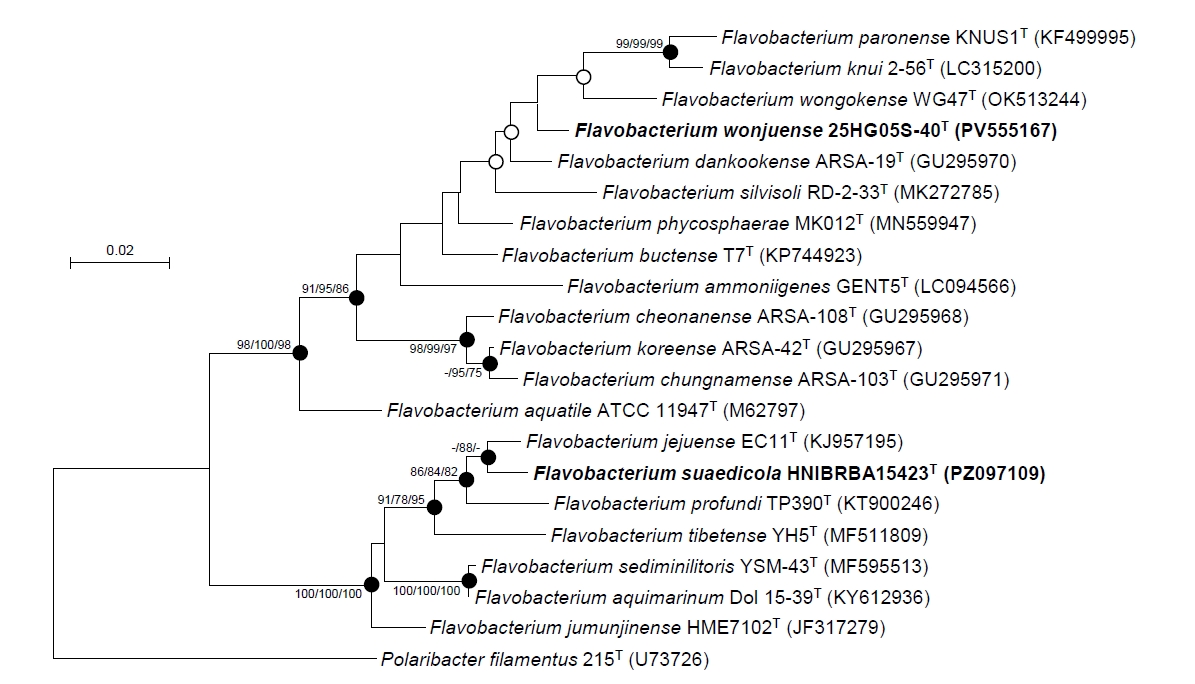
The almost-complete 16S rRNA gene sequences of strains HNIBRBA15423T (1,467 bp) and 25HG05S-40T (1,463 bp) were deposited in GenBank. The 16S rRNA gene sequence of strain HNIBRBA15423T showed the highest similarities to those of Flavobacterium jejuense EC11T (98.5%), F. profundi TP390T (97.2%), and F. jumunjinense HME7102T (96.8%), whereas that of strain 25HG05S-40T showed the highest similarities to those of F. dankookense ARSA-19T (98.1%), F. phycosphaerae MK012T (97.5%), and F. buctense T7T (96.8%). The 16S rRNA gene sequence similarity between strains HNIBRBA15423T and 25HG05S-40T was 91.3%. In all 16S rRNA gene-based phylogenetic trees generated using the three inferring methods, strains HNIBRBA15423T and 25HG05S-40T were placed within a cluster comprising Flavobacterium species (Fig. 1). Strain HNIBRBA15423T formed a robust subclade with F. jejuense and F. profundi, which was supported by 82–88% bootstrap values. However, Strain 25HG05S-40T formed a loose subclade with F. dankookense and F. phycosphaerae, and its phylogenetic position was further resolved by genome-based phylogenetic analysis.
Genome features
The genomes of strains HNIBRBA15423T and 25HG05S-40T were sequenced using the PacBio HiFi system with 232.0× and 308.0× in depth, respectively. After assembly, the complete genomes of strains HNIBRBA15423T and 25HG05S-40T were 4,299,722 bp and 3,455,619 bp in length, and were deposited at the GenBank database. CheckM analysis revealed high genome completeness and low contamination for both strains, with completeness and contamination estimates of 99.5% and 0.5% for strain HNIBRBA15423T, and 99.1% and 0.9% for strain 25HG05S-40T, respectively. The complete genomes of strains HNIBRBA15423T and 25HG05S-40T were each assembled into a single, closed circular chromosome with no gaps. The DNA G + C contents of the genomes were 29.7% and 36.6%, which are within the genus range (29.4–50.9%). Based on the PGAP results, 3,812 and 3,032 genes were predicted for strains HNIBRBA15423T and 25HG05S-40T, respectively. These genomes included 3,731 and 2,965 protein-coding genes, 49 and 43 tRNA genes, and three copies of 16S rRNA genes for each, respectively (Table S1). The three copies of the 16S rRNA gene sequences on each genome were identical to their PCR-amplified counterparts.
The HNIBRBA15423T and 25HG05S-40T genomes commonly harbored diverse metabolic pathways such as gluconeogenesis, tricarboxylic acid (TCA) cycle, biotin synthesis, and ABC transporters of lipoproteins and lipopolysaccharides. Alpha-amylase (EC 3.2.1.1) was identified in both genomes, consistent with the starch-hydrolyzing activity observed in both strains. Metabolic pathway annotation revealed that the genome of strain HNIBRBA15423T harbored genes associated with thiamine biosynthesis and nitric oxide (NO) and nitrous oxide (N₂O) reductases (norBC and nosZ). Meanwhile, the 25HG05S-40T genome harbored a set of genes encoding NADH dehydrogenase complex type I (nuoA-N) a highly energy-efficient respiratory complex (Archer and Elliott, 1995).
CAZyme annotation revealed differences in the carbohydrate-active enzyme profiles of strains HNIBRBA15423T and 25HG05S-40T. Strain HNIBRBA15423T was found to possess a total of 156 CAZymes, comprising 4 auxiliary activities (AAs), 20 carbohydrate-binding modules (CBMs), 8 carbohydrate esterases (CEs), 57 glycoside hydrolases (GHs), 62 glycosyltransferases (GTs), and 5 polysaccharide lyases (PLs). In comparison, strain 25HG05S-40T contained 113 CAZymes, including 3 AAs, 7 CBMs, 6 CEs, 40 GHs, and 57 GTs, with no PLs detected. In accordance with the presence of diverse GHs in both strains, HNIBRBA15423T and 25HG05S-40T exhibited hydrolytic activity toward both starch and CM-cellulose. Further analysis of the GH complement identified genes belonging to glycoside hydrolase family 5 subfamily 7 (GH5_7; YAF06204.1 in HNIBRBA15423T and YAE87798.1 in 25HG05S-40T) in both strains. As members of GH5_7 include enzymes capable of hydrolyzing β-1,4-linked glucans, the presence of these genes is consistent with the CM-cellulose-hydrolyzing activity observed in both strains. In addition, strain HNIBRBA15423T harbored a gene assigned to glycoside hydrolase family 12 (GH12; YAF06279.1), a family that includes endo-β-1,4-glucanases involved in the hydrolysis of β-1,4-glucans. Thus, the phenotypic hydrolysis of starch and CM-cellulose, together with the identified CAZyme complement, further supports the carbohydrate-degrading potential of both strains. These distinct genomic characteristics reflect the metabolic diversity between the two novel strains.
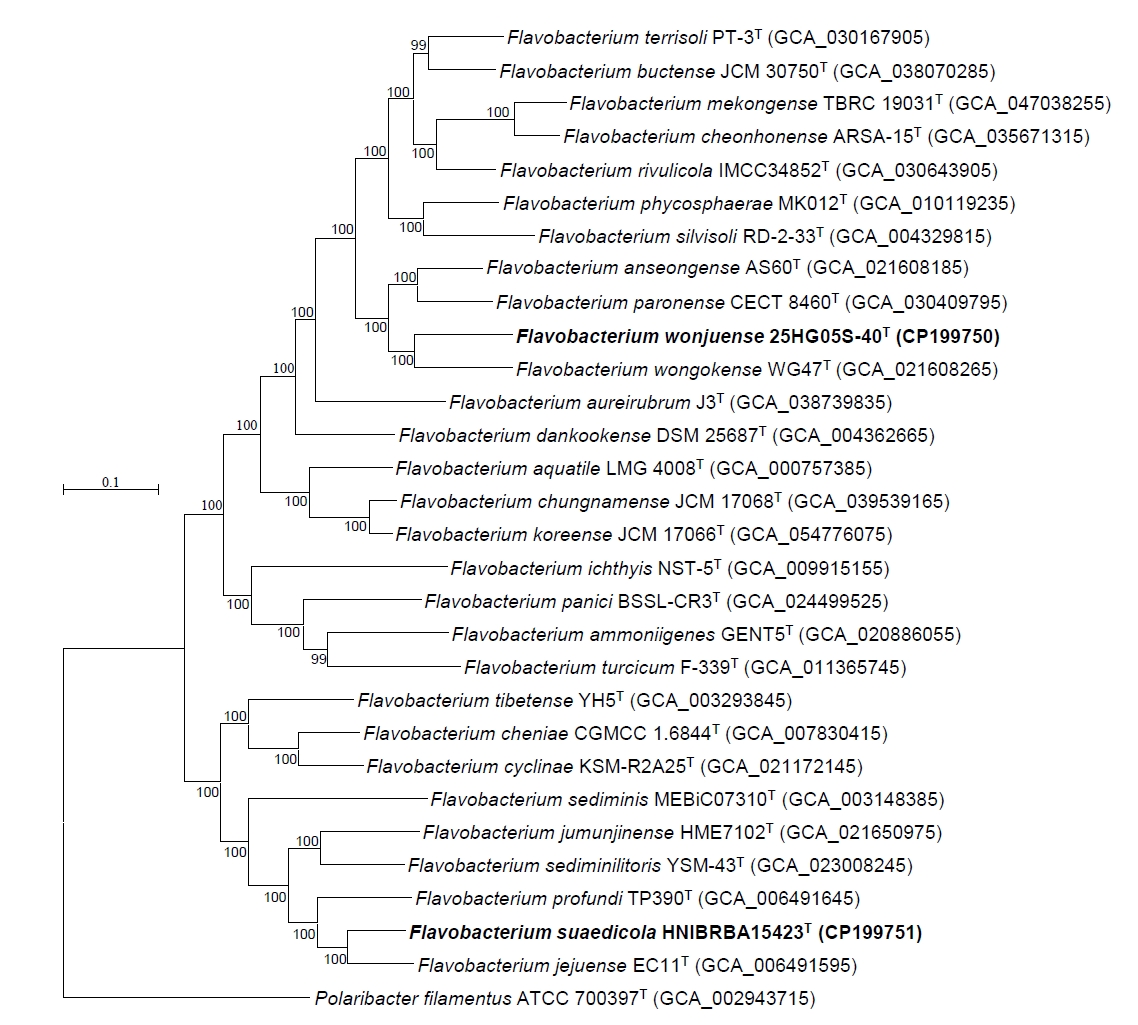
In the phylogenomic trees, strains HNIBRBA15423T and 25HG05S-40T formed a robust clade with other Flavobacterium genomes (Fig. 2). Strain HNIBRBA15423T formed a robust clade with F. jejuense EC11T and the ANI and dDDH values between the two strains were 85.2% and 29.5%, respectively. Strain 25HG05S-40T formed a robust clade with F. wongokense WG47T and the ANI and dDDH values between the two strains were 78.6% and 21.5%, respectively (Table S3). These values were below the standard criteria values for species delineation of ANI (95–96%) and dDDH (70%) (Chun et al., 2018; Goris et al., 2007; Richter and Rosselló-Móra, 2009), indicating that strains HNIBRBA15423T and 25HG05S-40T represent novel species of the genus Flavobacterium.
Morphological, physiological, and biochemical characterization
Strains HNIBRBA15423T and 25HG05S-40T were Gram-stain-negative and rod-shaped (Fig. S1). Both strains grew optimally at 25°C. Strain HNIBRBA15423T grew at 4–30°C, pH 6.0–9.0 (optimum, pH 8.0), and with 0–5% NaCl (optimum, 1%). Strain 25HG05S-40T grew at 10–35°C, pH 6.0–9.0 (optimum, pH 7.0), and with 0–1% NaCl (optimum, 0.5%). Both strains were positive for oxidase and catalase activities. No growth was observed under anaerobic conditions using AnaeroPack, indicating that both strains are aerobic. Marine strains, including HNIBRBA15423T, F. jejuense KCTC 42149T, and F. profundi KACC 18559T showed 5% NaCl tolerance, whereas freshwater and soil strains 25HG05S-40T, F. dankookense KCTC 23179T, and F. aquatile KACC 11692T exhibited lower NaCl tolerance. In terms of macromolecule hydrolysis, only strains HNIBRBA15423T and F. profundi KACC 18559T hydrolyzed DNA, starch, casein, and CM-cellulose. Other phenotypic characteristics are listed in Tables 1 and S1.
The major cellular fatty acids (> 10% of the total fatty acids) for both strains were iso-C15:0, iso-C15:1 G, and iso-C17:0 3-OH. Additionally, strain 25HG05S-40T contained iso-C15:0, iso-C15:1 G, iso-C17:0 3-OH, and summed feature 9 (iso-C17:1 ω9c and/or 10-methyl C16:0) (Table 2). The fatty acid profiles of strains HNIBRBA15423T and 25HG05S-40T shared several major components with those of the related Flavobacterium type strains, such as iso-C15:0, iso-C15:1 G, and iso-C17:0 3-OH. However, quantitative differences were observed among the strains including summed feature 9, C15:1 ω6c, and iso-C16:0. The predominant respiratory quinone for both novel strains was menaquinone-6 (MK-6). The polar lipids of strain HNIBRBA15423T consisted of phosphatidylethanolamine (PE), four unidentified aminolipids, an unidentified aminophospholipid (APL), and ten unidentified lipids. The polar lipid profile of strain 25HG05S-40T consisted of PE, four unidentified aminolipids, and two unidentified lipids (Fig. S2). These chemotaxonomic features, including iso-C15:0 as the major fatty acid, MK-6 as the sole respiratory quinone and PE as the major polar lipid, confirmed the affiliation of both strains to the genus Flavobacterium. Overall, strain HNIBRBA15423T could be differentiated from F. jejuense by its ability to grow at 4°C, colony morphology, nitrate reduction, and starch hydrolysis. Strain 25HG05S-40T could be differentiated from F. dankookense KCTC 23179T and F. wongokense WG47T by its growth temperature range, enzyme activities, and ability to hydrolyze starch and casein.
Taxonomical conclusion
Strains HNIBRBA15423T and 25HG05S-40T could be clearly distinguished from their closest relatives by a number of phenotypic characteristics such as colony morphology, temperature range for growth, NaCl tolerance, enzyme activities, degradation capabilities including DNA and starch, and the compositions of cellular fatty acids. The 16S rRNA gene sequence similarities between strain HNIBRBA15423T and F. jejuense (98.5%), and between strain 25HG05S-40T and F. dankookense (98.3%) indicated their affiliation with the genus Flavobacterium. Furthermore, the low ANI (85.2% and 76.0%) and dDDH values (29.5% and 20.3%) between the two novel strains and their respective closest type strains were well below the widely accepted thresholds for species delineation. Taken together, the integrated phylogenetic, genomic, physiological, and chemotaxonomic data support that strains HNIBRBA15423T and 25HG05S-40T represent two distinct novel species of the genus Flavobacterium. Therefore, the names Flavobacterium suaedicola sp. nov. and Flavobacterium wonjuense sp. nov. are proposed, with HNIBRBA15423T and 25HG05S-40T as the type strains, respectively.
Description of Flavobacterium suaedicola sp. nov.
Flavobacterium suaedicola (su.ae.di’co.la. N.L. fem. n. Suaeda, a botanical genus name; L. masc./fem. n. suff. -cola, dweller; N.L. masc./fem. n. suaedicola, a dweller of the plant Suaeda, referring to the isolation of the type strain from the halophyte Suaeda maritima).
Cells are Gram-stain-negative, aerobic, non-motile, and rod-shaped, approximately 2.2–4.9 µm in length and 0.3–0.4 µm in width. Colonies on R2A agar are yellow-pigmented, irregular, and convex. Growth occurs at 4–30°C (optimum, 25°C), at pH 6.0–9.0 (optimum, pH 8.0) and with 0–5% NaCl (optimum 1% NaCl). Oxidase- and catalase-activities are positive. In the API 20NE strip, esculin hydrolysis and gelatinase activity are positive, but nitrate reduction, indole production, glucose fermentation, arginine dihydrolase, urease, and β-galactosidase are negative. In the API ZYM strip, alkaline phosphatase, esterase (C4), esterase lipase (C8), leucine arylamidase, valine arylamidase, cystine arylamidase, trypsin, naphthol-AS-BI-phosphohydrolase, α-glucosidase, and β-glucosidase activities are positive; but lipase (C14), α-chymotrypsin, acid phosphatase, α-galactosidase, β-galactosidase, β-glucuronidase, N-acetyl-β-glucosaminidase, α-mannosidase, and α-fucosidase activities are negative. DNA, starch, casein, and CM-cellulose are hydrolyzed. The major cellular fatty acids (> 10%) are iso-C15:0, iso-C15:1 G, and iso-C17:0 3-OH. The only respiratory quinone is MK-6. The polar lipids are phosphatidylethanolamine, four unidentified aminolipids, an unidentified aminophospholipid, and ten unidentified lipids.
The type strain is HNIBRBA15423T (= HNIBR-BC8745T = MCCC 1K10276T), isolated from the root of a halophyte associated with the halophyte Suaeda maritima in Taean, Republic of Korea. The length of the complete genome sequence of the type strain is 4.29 Mb with a DNA G + C content of 29.7%. GenBank accession numbers for the 16S rRNA gene sequence and the complete genome sequence of the type strain are PZ097109 and CP199751, respectively.
Description of Flavobacterium wonjuense sp. nov.
Flavobacterium wonjuense (won.ju.en’se. N.L. neut. adj. wonjuense, of or pertaining to Wonju, a city in Gangwon Province, Republic of Korea, from where the type strain was isolated).
Cells are Gram-stain-negative, aerobic, non-motile, and rod-shaped, approximately 1.2–2.3 µm in length and 0.4–0.5 µm in width. Colonies on R2A agar are yellow-pigmented, convex, and circular with entire margins. Growth occurs at 10–35°C (optimum, 25°C), at pH 6.0–9.0 (optimum, pH 7.0), and with 0–1% NaCl (optimum 0.5% NaCl). Oxidase- and catalase-activities are positive. In the API 20NE strip, esculin hydrolysis is weakly positive, but nitrate reduction, indole production, glucose fermentation, arginine dihydrolase, urease, gelatinase, and β-galactosidase are negative. In the API ZYM strip, alkaline phosphatase, leucine arylamidase, valine arylamidase, and cystine arylamidase activities are positive; but esterase (C4), esterase lipase (C8), lipase (C14), trypsin, α-chymotrypsin, acid phosphatase, naphthol-AS-BI-phosphohydrolase, α-galactosidase, β-galactosidase, β-glucuronidase, α-glucosidase, β-glucosidase, N-acetyl-β-glucosaminidase, α-mannosidase, and α-fucosidase activities are negative. Starch, casein, and CM-cellulose are hydrolyzed, but DNA is negative. The major cellular fatty acids (> 10%) are iso-C15:0, iso-C15:1 G, iso-C17:0 3-OH, and summed feature 9 (iso-C17:1 ω9c and/or 10-methyl C16:0). The only respiratory quinone is MK-6. The polar lipids are phosphatidylethanolamine, four unidentified aminolipids, and two unidentified lipids.
The type strain is 25HG05S-40T (= FBCC-B19464T = MCCC 1K10173T), isolated from a river in the Republic of Korea. The length of the complete genome sequence of the type strain is 3.45 Mb with a DNA G + C content of 36.6%. GenBank accession numbers for the 16S rRNA gene sequence and the complete genome sequence of the type strain are PV555167 and CP199750, respectively.
Acknowledgments
This study was supported by the research grant “Survey of Indigenous Species in Korean Islands” (HNIBR2026-A-1-05) from the Honam National Institute of Biological Resources (HNIBR) and “Research on Freshwater Microbial Species Diversity (Prokaryotes)” (NNIBR20261102) from Nakdonggang National Institute of Biological Resources (NNIBR) of the Ministry of Climate, Energy and Environment in Korea.
Author Contributions
J.S. and A.C. conceptualized the idea. S.Y.S., H.K., and Y.J. performed the experiments and data analysis. S.Y.S., H.K., and J.S. wrote the manuscript. S.I.H., and A.C. provided critical feedback and revised the manuscript. All authors read and approved the final manuscript.
Conflict of Interest
The authors have no financial conflicts of interest to declare.
Supplementary Information
The online version contains supplementary material available at https://doi.org/10.71150/jm.2607006
Table S2.
Pairwise genomic relatedness between strain HNIBRBA15423T, 25HG05S-40T, and closely related Flavobacterium species based on16S rRNA gene, and average nucleotide identity (ANI), and digital DNA–DNA hybridization (dDDH)
jm-2607006-Supplementary-Table-S2.pdf
Table S3.
Carbon source utilization patterns (GENIII MicroPlate) of the Flavobacterium strains Strains: 1, HNIBRBA15423T, 2, 25HG05S-40T, 3, F. jejuense KCTC 42149T, 4, F. profundi KACC 18559T, 5, F. dankookense KCTC 23179T, 6, F. aquatile KACC 11692T, All data were obtained in this study. +, positive; -, negative. All positive for D-maltose, α-D-glucose, D-mannose, gelatin, L-glutamic acid, and all negative for D-trehalose, D-turanose, stachyose, D-raffinose, α-D-lactose, D-melibiose, β-methyl-D-glucoside, D-salicin, N-acetyl-D-glucosamine, N-acetyl-β-D-mannosamine, N-acetyl-D-galactosamine, N-acetyl neuraminic acid, 3-methyl glucose, D-fucose, L-fucose, L-rhamnose, inosine, D-sorbitol, D-mannitol, D-arabitol, myo-Inositol, glycerol, D-fructose-6-phosphate, D-aspartic acid, D-serine, L-alanine, L-histidine, L-pyroglutamic acid, D-gluconic acid, D-glucuronic acid, mucic acid, quinic acid, D-saccharic acid, p-hydroxy-phenylacetic acid, methyl pyruvate, D-lactic acid methyl ester, L-lactic acid, citric acid, α-keto-glutaric acid, D-malic acid, γ-amino-butyric acid, α-hydroxy-butyric acid, α-keto-butyric acid, propionic acid, and formic acid.
jm-2607006-Supplementary-Table-S3.pdf
Fig. 1.Phylogenetic tree showing the position of strains HNIBRBA15423T and 25HG05S-40T. Maximum-likelihood phylogenetic tree based on almost full-length 16S rRNA gene sequences showing the relationships between strains HNIBRBA15423T, 25HG05S-40T, and the related type strains. Bootstrap values based on 1,000 replications over 70% are shown at nodes for maximum-likelihood, neighbor-joining and minimum-evolution methods, respectively. Filled circles indicate that the corresponding nodes were recovered by three methods. Polaribacter filamentus 215T (U73726) was used as outgroup. Bar = 0.02 substitutions per nucleotide position.
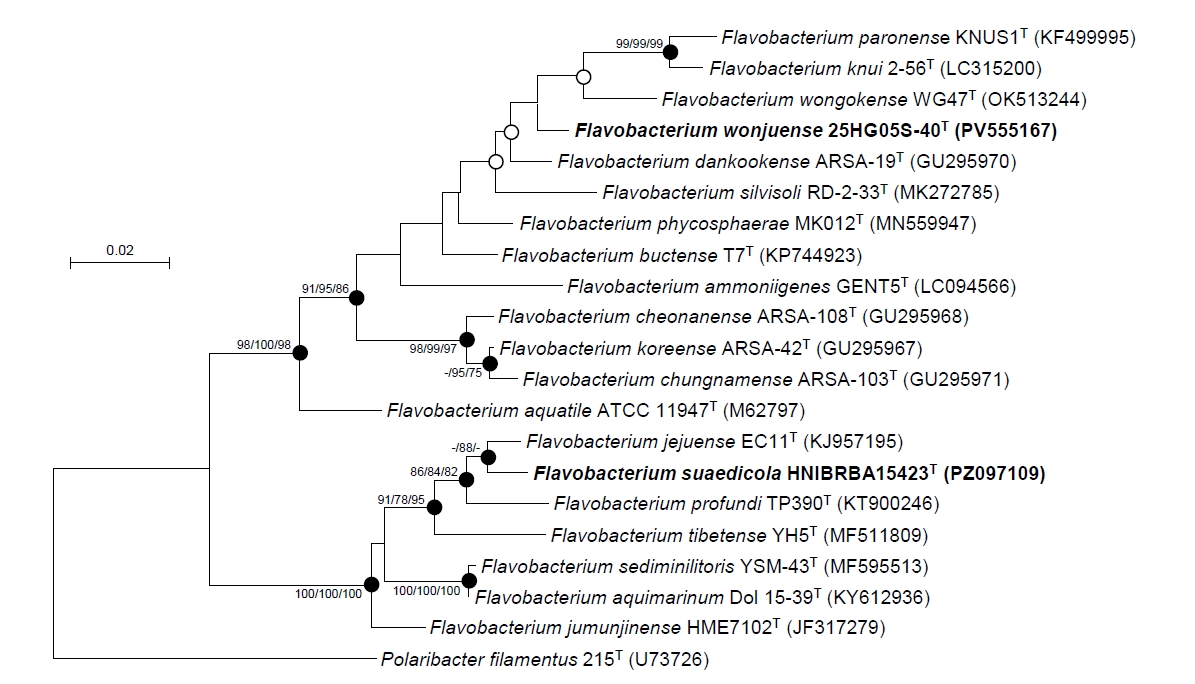
Fig. 2.Phylogenomic tree including genomes of strains HNIBRBA15423T and 25HG05S-40T, and other Flavobacterium species. The tree was reconstructed using the multiple-alignment of the 92 bacterial core genes. The genome sequence of Polaribacter filamentus ATCC 700397T was used as an outgroup. Bootstrap values are shown at nodes. Bar = 0.1 substitutions per nucleotide position.
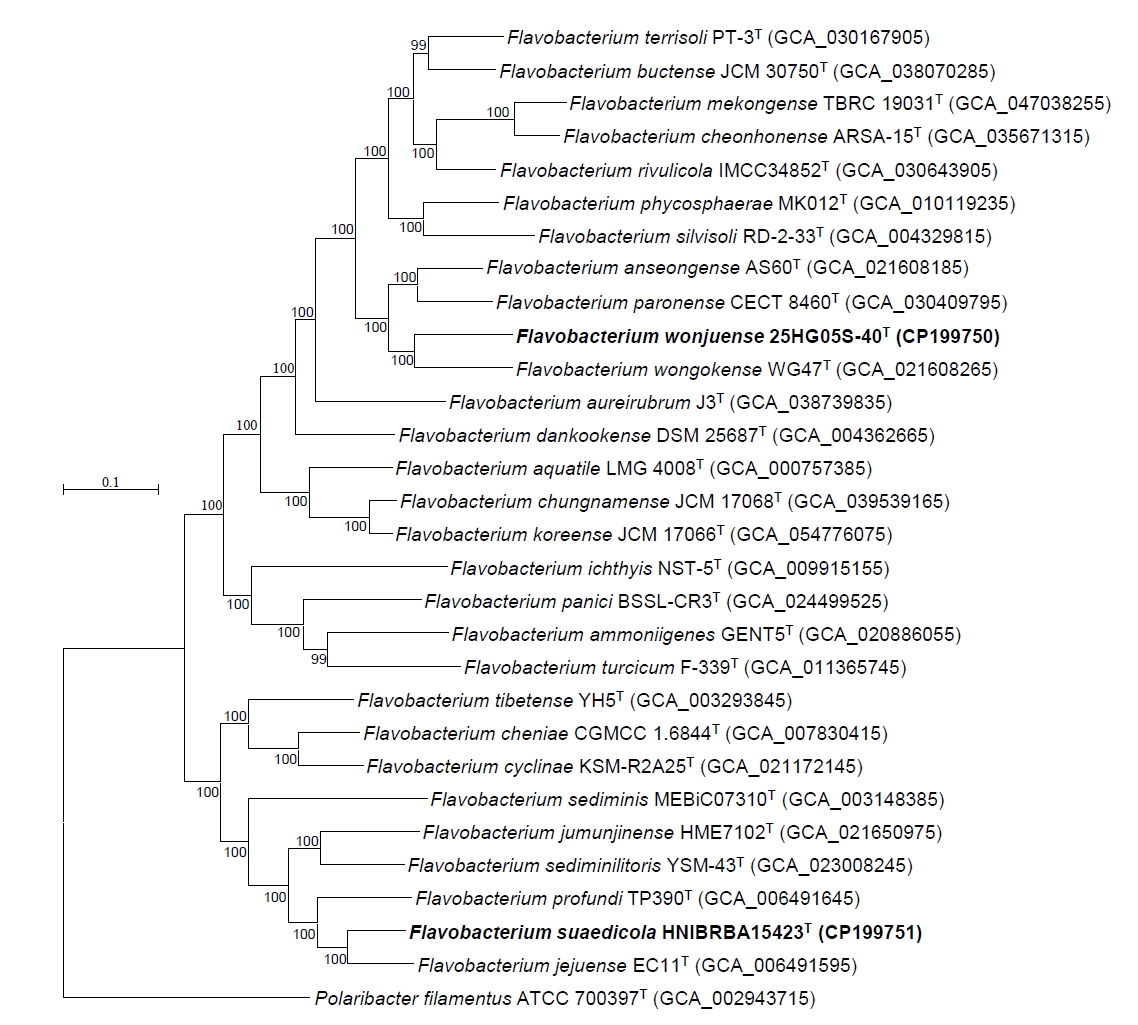
Table 1.
Phenotypic characteristics of strains HNIBRBA15423T, 25HG05S-40T, and other Flavobacterium species
Strains: 1, HNIBRBA15423T; 2, 25HG05S-40T; 3. F. jejuense KCTC 42149T; 4. F. profundi KACC 18559T; 5. F. dankookense KCTC 23179T; 6. F. wongokense WG47T, 7. F. aquatile KACC 11692T. Data are from this study unless otherwise indicated. All strains were positive for esculin hydrolysis, catalse, and oxidase. All strains were negative for activities of indole production, glucose fermentation, arginine dihydrolase, urease, β-galactosidase, lipase (C14), α-chymotrypsin, α-galactosidase, β-glucuronidase, N-acetyl-β-glucosaminidase, α-mannosidase, and α-fucosidase. +, positive; −, negative; A, aerobic; FA, facultatively anaerobic.
|
Characteristics |
1 |
2 |
3 |
4 |
5 |
6d
|
7 |
|
Isolation source |
root |
soil |
algaea
|
deep-sea sedimentb
|
freshwaterc
|
freshwater |
freshwatere
|
|
Colony morphology |
irregular |
circular |
circulara
|
circularb
|
circularc
|
circular |
circulare
|
|
Temperature range (℃) |
4–30 |
10–35 |
10–30a
|
4–35b
|
4–37c
|
10–30 |
10–30c
|
|
pH range |
6.0–9.0 |
6.0–9.0 |
6.0–10.5a
|
6.0–9.0b
|
6.5–9.5c
|
6.5–9.5 |
6.5–8.0f
|
|
NaCl range (%) |
0–5 |
0–1 |
0–5a
|
0–5b
|
0–1c
|
0–0.5 |
0–0.5f
|
|
NaCl optimum |
1 |
0.5 |
1–2a
|
1b
|
0c
|
0 |
0e
|
|
Requirement for oxygen |
A |
A |
Aa
|
FAb
|
Ac
|
A |
Ae
|
|
Activities of |
|
|
|
|
|
|
|
|
Nitrate reduction |
- |
- |
+ |
- |
- |
- |
- |
|
Gelatinase |
+ |
- |
+ |
- |
- |
- |
- |
|
Esterase (C4) |
+ |
- |
+ |
+ |
+ |
+ |
+ |
|
Esterase lipase (C8) |
+ |
- |
+ |
+ |
+ |
+ |
+ |
|
Trypsin |
+ |
- |
+ |
+ |
- |
- |
- |
|
Acid phosphatase |
- |
- |
+ |
+ |
+ |
+ |
+ |
|
Naphthol-AS-BI-Phosphohydrolase |
+ |
- |
- |
- |
+ |
+ |
+ |
|
α-Glucosidase |
+ |
- |
+ |
+ |
- |
- |
+ |
|
β-Glucosidase |
+ |
- |
- |
- |
- |
- |
- |
|
Macromolecule hydrolysis |
|
|
|
|
|
|
|
|
DNA |
+ |
- |
+ |
+ |
- |
- |
- |
|
Starch |
+ |
+ |
- |
+ |
+ |
- |
+ |
|
Casein |
+ |
+ |
+ |
+ |
- |
+ |
+ |
|
CM-cellulose |
+ |
+ |
+ |
+ |
- |
- |
- |
Table 2.
Cellular fatty acid composition of strains HNIBRBA15423T, 25HG05S-40T, and other Flavobacterium species
Strains: 1, HNIBRBA15423T; 2, 25HG05S-40T; 3, F. jejuense KCTC 42149T; 4, F. profundi KACC 18559T; 5, F. dankookense KCTC 23179T; 6, F. wongokense WG47T; 7, F. aquatile KACC 11692T. All data were obtained in the present study except for those of F. wongokense WG47T. -, not detected; tr, < 1%.
|
Fatty acids |
1 |
2 |
3 |
4 |
5 |
6a
|
7 |
|
Saturated |
|
|
|
|
|
|
|
|
C16:0
|
- |
- |
- |
tr |
tr |
2.5 |
tr |
|
Hydroxylated |
|
|
|
|
|
|
|
|
C15:0 3-OH |
- |
- |
- |
- |
- |
- |
3.9 |
|
C16:0 3-OH |
- |
- |
- |
tr |
- |
4.5 |
- |
|
C17:0 2-OH |
- |
- |
tr |
- |
1.3 |
tr |
2.1 |
|
iso-C15:0 3-OH |
8.0 |
9.2 |
7.4 |
6.7 |
7.4 |
9.5 |
6.4 |
|
iso-C16:0 3-OH |
4.9 |
2.3 |
2.3 |
2.5 |
3.8 |
4.5 |
4.5 |
|
iso-C17:0 3-OH |
12.8 |
14.6 |
12.9 |
12.0 |
10.7 |
14.6 |
6.3 |
|
Branched |
|
|
|
|
|
|
|
|
iso-C13:0
|
tr |
- |
1.0 |
tr |
- |
- |
- |
|
iso-C14:0
|
1.3 |
- |
1.5 |
1.5 |
1.0 |
tr |
1.1 |
|
iso-C15:0
|
24.5 |
23.4 |
25.9 |
28.0 |
24.3 |
16.4 |
18.1 |
|
iso-C15:1 G |
19.9 |
17.5 |
22.2 |
23.1 |
9.7 |
6.4 |
10.3 |
|
iso-C16:0
|
2.4 |
2.9 |
2.3 |
2.2 |
7.2 |
12.6 |
2.1 |
|
iso-C16:1 H |
2.4 |
- |
2.0 |
1.5 |
2.2 |
1.6 |
1.2 |
|
iso-C17:0
|
|
|
|
|
1.0 |
- |
|
|
anteiso-C15:0
|
2.0 |
2.1 |
1.6 |
tr |
2.6 |
tr |
6.3 |
|
anteiso-C15:1 A |
tr |
1.9 |
tr |
- |
tr |
- |
2.5 |
|
Unsaturated |
|
|
|
|
|
|
|
|
C15:1 ω6c
|
7.1 |
5.5 |
5.6 |
5.3 |
3.4 |
3.3 |
22.2 |
|
C17:1 ω6c
|
tr |
4.6 |
tr |
- |
1.9 |
3.1 |
1.1 |
|
C17:1 ω8c
|
2.7 |
3.0 |
1.8 |
2.1 |
2.5 |
2.4 |
5.6 |
|
anteiso-C17:1 ω9c
|
- |
- |
- |
- |
1.6 |
- |
- |
|
Summed features*
|
|
|
|
|
|
|
|
|
3 |
4.7 |
3.1 |
3.4 |
6.0 |
4.6 |
5.4 |
3.1 |
|
4 |
1.5 |
- |
1.3 |
1.7 |
- |
- |
- |
|
9 |
3.2 |
10.2 |
5.3 |
2.4 |
10.8 |
4.6 |
2.0 |
References
- Archer CD, Elliott T. 1995. Transcriptional control of the nuo operon which encodes the energy-conserving NADH dehydrogenase of Salmonella typhimurium. J Bacteriol. 177: 2335–2342. ArticlePMCLink
- Bergey DH, Harrison FC, Breed RS, Hammer BW, Huntoon FM. 1923. Bergey's manual of determinative bacteriology, 1st edn. The Williams & Wilkins Co. Link
- Bernardet JF, Bowman JP. 2006. The genus Flavobacterium. In Dworkin M, Falkow S, Rosenberg E, Schleifer KH, Stackebrandt E. (eds.), The prokaryotes, pp. 481–531. Springer. Article
- Bernardet JF, Nakagawa Y, Holmes B. 2002. Proposed minimal standards for describing new taxa of the family Flavobacteriaceae and emended description of the family. Int J Syst Evol Microbiol. 52: 1049–1070. ArticlePubMed
- Bernardet JF, Segers P, Vancanneyt M, Berthe F, Kersters K, et al. 1996. Cutting a Gordian knot: Emended classification and description of the genus Flavobacterium, emended description of the family Flavobacteriaceae, and proposal of Flavobacterium hydatis nom. nov. (Basonym, Cytophaga aquatilis Strohl and Tait 1978). Int J Syst Evol Microbiol. 46: 128–148. Article
- Chalita M, Kim YO, Park S, Oh HS, Cho J, et al. 2024. EzBioCloud: A genome-driven database and platform for microbiome identification and discovery. Int J Syst Evol Microbiol. 74: 006421.Article
- Chun J, Oren A, Ventosa A, Christensen H, Arahal DR, et al. 2018. Proposed minimal standards for the use of genome data for the taxonomy of prokaryotes. Int J Syst Evol Microbiol. 68: 461–466. ArticlePubMed
- Collins MD, Jones D. 1981. Distribution of isoprenoid quinone structural types in bacteria and their taxonomic implication. Microbiol Rev. 45: 316–354. ArticleLink
- Dong K, Chen F, Du Y, Wang G. 2013. Flavobacterium enshiense sp. nov., isolated from soil, and emended descriptions of the genus Flavobacterium and Flavobacterium cauense, Flavobacterium saliperosum and Flavobacterium suncheonense. Int J Syst Evol Microbiol. 63: 886–892. Article
- Felsenstein J. 1981. Evolutionary trees from DNA sequences: A maximum likelihood approach. J Mol Evol. 17: 368–376. ArticlePDF
- Felsenstein J. 1985. Confidence limits on phylogenies: An approach using the bootstrap. Evolution. 39: 783–791. ArticleLink
- Fitch WM. 1971. Toward defining the course of evolution: Minimum change for a specific tree topology. Syst Biol. 20: 406–416. Article
- Goris J, Konstantinidis KT, Klappenbach JA, Coenye T, Vandamme P, et al. 2007. DNA–DNA hybridization values and their relationship to whole-genome sequence similarities. Int J Syst Evol Microbiol. 57: 81–91. ArticlePubMed
- Jo JH, Lee S, Chun SY, Im WT. 2025. Flavobacterium anseongense sp. nov. and Flavobacterium wongokense sp. nov., isolated from freshwater and freshwater soil in South Korea. Int J Syst Evol Microbiol. 75: 006724.Article
- Jo H, Park MS, Lim Y, Kang I, Cho JC. 2023. Ten novel species belonging to the genus Flavobacterium, isolated from freshwater environments: F. praedii sp. nov., F. marginilacus sp. nov., F. aestivum sp. nov., F. flavigenum sp. nov., F. luteolum sp. nov., F. gelatinilyticum sp. nov., F. aquiphilum sp. nov., F. limnophilum sp. nov., F. lacustre sp. nov., and F. eburneipallidum sp. nov. J Microbiol. 61: 495–510. ArticlePubMed
- Kämpfer P, Irgang R, Glaeser SP, Busse HJ, Criscuolo A, et al. 2020. Flavobacterium salmonis sp. nov. isolated from Atlantic salmon (Salmo salar) and formal proposal to reclassify Flavobacterium spartansii as a later heterotypic synonym of Flavobacterium tructae. Int J Syst Evol Microbiol. 70: 6147–6154. ArticlePubMed
- Kämpfer P, Lipski A, Lawrence KS, Olive WR, Newman MM, et al. 2025. Flavobacterium plantiphilum sp. nov., Flavobacterium rhizophilum sp. nov., Flavobacterium rhizosphaerae sp. nov., Chryseobacterium terrae sp. nov., and Sphingomonas plantiphila sp. nov. isolated from salty soil showing plant growth promoting potential. Syst Appl Microbiol. 48: 126588.ArticlePubMed
- Kanehisa M, Sato Y, Morishima K. 2016. BlastKOALA and GhostKOALA: KEGG tools for functional characterization of genome and metagenome sequences. J Mol Biol. 428: 726–731. ArticlePubMed
- Kang JY, Chun J, Jahng KY. 2013. Flavobacterium aciduliphilum sp. nov., isolated from freshwater, and emended description of the genus Flavobacterium. Int J Syst Evol Microbiol. 63: 1633–1638. ArticlePubMed
- Kim M, Cha I, Lee K, Li M, Park S. 2023. Pangenome analysis provides insights into the genetic diversity, metabolic versatility, and evolution of the genus Flavobacterium. Microbiol Spectr. 11: e01003-23.ArticlePubMedPMC
- Kitahara K, Muzembo BA, Morohoshi S, Kunihiro T, Tazato N, et al. 2023. Flavobacterium okayamense sp. nov. isolated from surface seawater. Arch Microbiol. 205: 346.ArticlePubMedPMCPDF
- Kuo I, Saw J, Kapan DD, Christensen S, Kaneshiro KY, et al. 2013. Flavobacterium akiainvivens sp. nov., from decaying wood of Wikstroemia oahuensis, Hawai’i, and emended description of the genus Flavobacterium. Int J Syst Evol Microbiol. 63: 3280–3286. ArticlePubMed
- Lee S, Weon HY, Han K, Ahn TY. 2012. Flavobacterium dankookense sp. nov., isolated from a freshwater reservoir, and emended descriptions of Flavobacterium cheonanense, F. chungnamense, F. koreense and F. aquatile. Int J Syst Evol Microbiol. 62: 2378–2382. ArticlePubMed
- Lian XD, Guan Y, Jiang Y, Kwak DH, Lee MK, et al. 2025. Discovery of two novel Flavobacterium species with potential for complex polysaccharide degradation. Sci Rep. 15: 3494.ArticlePubMedPMCPDF
- Meier-Kolthoff JP, Sardà Carbasse J, Peinado-Olarte RL, Göker M. 2022. TYGS and LPSN: A database tandem for fast and reliable genome-based classification and nomenclature of prokaryotes. Nucleic Acids Res. 50: D801–D807. ArticlePubMedPMCPDF
- Minnikin DE, O'Donnell AG, Goodfellow M, Alderson G, Athalye M, et al. 1984. An integrated procedure for the extraction of bacterial isoprenoid quinones and polar lipids. J Microbiol Methods. 2: 233–241. Article
- Minnikin DE, Patel PV, Alshamaony L, Goodfellow M. 1977. Polar lipid composition in the classification of Nocardia and related bacteria. Int J Syst Bacteriol. 27: 104–117. Article
- Na SI, Kim YO, Yoon SH, Ha SM, Baek I, et al. 2018. UBCG: Up-to-date bacterial core gene set and pipeline for phylogenomic tree reconstruction. J Microbiol. 56: 280–285. ArticlePubMedPDF
- Park SH, Kim JY, Kim YJ, Heo MS. 2015. Flavobacterium jejuense sp. nov., isolated from marine brown alga Ecklonia cava. J Microbiol. 53: 756–761. ArticlePubMedPDF
- Parte AC, Sardà Carbasse J, Meier-Kolthoff JP, Reimer LC, Göker M. 2020. List of prokaryotic names with standing in nomenclature (LPSN) moves to the DSMZ. Int J Syst Evol Microbiol. 70: 5607–5612. ArticlePubMedPMC
- Price MN, Dehal PS, Arkin AP. 2009. FastTree: Computing large minimum evolution trees with profiles instead of a distance matrix. Mol Biol Evol. 26: 1641–1650. Article
- Richter M, Rosselló-Móra R. 2009. Shifting the genomic gold standard for the prokaryotic species definition. Proc Natl Acad Sci USA. 106: 19126–19131. Article
- Saitou N, Nei M. 1987. The neighbor-joining method: A new method for reconstructing phylogenetic trees. Mol Biol Evol. 4: 406–425. ArticlePubMed
- Sasser M. 1990. Identification of bacteria by gas chromatography of cellular fatty acids. MIDI Technical Note 101. MIDI Inc. PDF
- Tamura K, Stecher G, Kumar S. 2021. MEGA11: Molecular evolutionary genetics analysis version 11. Mol Biol Evol. 38: 3022–3027. ArticlePubMedPMCPDF
- Tatusova T, DiCuccio M, Badretdin A, Chetvernin V, Nawrocki EP, et al. 2016. NCBI prokaryotic genome annotation pipeline. Nucleic Acids Res. 44: 6614–6624. ArticlePubMedPMC
- Thompson JD, Higgins DG, Gibson TJ. 1994. CLUSTAL W: Improving the sensitivity of progressive multiple sequence alignment through sequence weighting, position-specific gap penalties and weight matrix choice. Nucleic Acids Res. 22: 4673–4680. ArticlePubMedPMC
- Wang Q, Cai SD, Liu J, Zhang DC. 2020. Flavobacterium profundi sp. nov., isolated from a deep-sea seamount. Int J Syst Evol Microbiol. 70: 3633–3638. ArticlePubMed
- Webster JA, Hugh R. 1979. Flavobacterium aquatile and Flavobacterium meningosepticum: Glucose nonfermenters with similar flagellar morphologies. Int J Syst Evol Microbiol. 29: 333–338. Article
- Weisburg WG, Barns SM, Pelletier DA, Lane DJ. 1991. 16S ribosomal DNA amplification for phylogenetic study. J Bacteriol. 173: 697–703. ArticlePubMedPMCLink
- Yang JK, Ding MY, Hu YT, Hong XZ, Han ZG, et al. 2025. Genome-wide analysis of Flavobacterium strain YJ01 demonstrates abundant enzymes synergistically degrade diverse natural carbohydrates. J Appl Microbiol. 136: lxae309.Article
- Yoon SH, Ha SM, Lim J, Kwon S, Chun J. 2017. A large-scale evaluation of algorithms to calculate average nucleotide identity. Antonie Van Leeuwenhoek. 110: 1281–1286. ArticlePubMedPDF
- Yoon JH, Kang SJ, Oh TK. 2006. Flavobacterium soli sp. nov., isolated from soil. Int J Syst Evol Microbiol. 56: 997–1000. Article
- Zheng J, Ge Q, Yan Y, Zhang X, Huang L, et al. 2023. dbCAN3: Automated carbohydrate-active enzyme and substrate annotation. Nucleic Acids Res. 51: W115–W121. ArticlePubMedPMCPDF
Citations
Citations to this article as recorded by

 MSK


 , Jaeho Song4,*


 ePub Link
 Cite this Article
 XML Download